European projects: connecting rural areas with Europe
A digital hub to explore 40 years of European history (1986–2026) from rural Cantabria
+ info 1457 views
Four posters, four European axes
Download in high resolution (posters in Spanish)
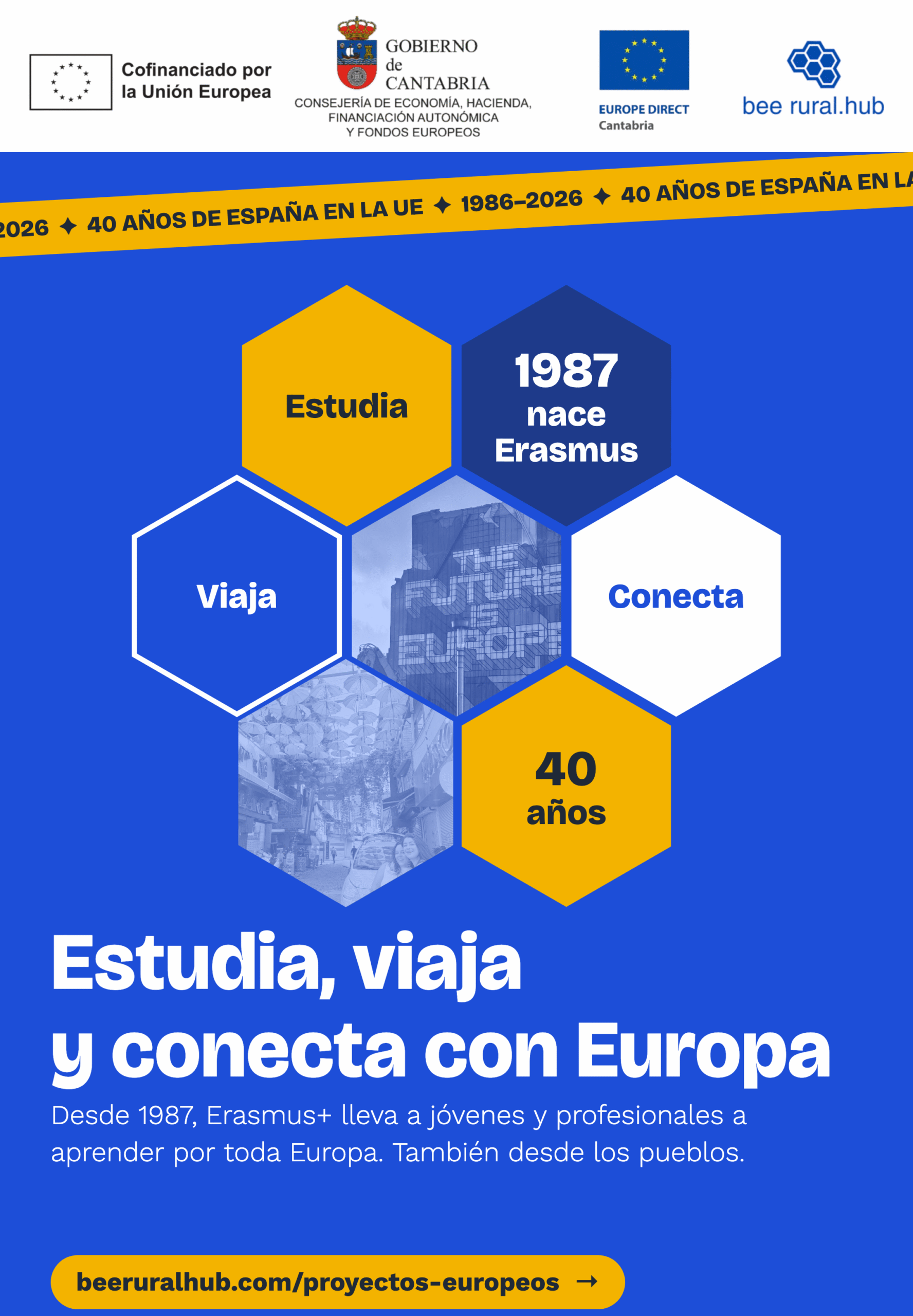
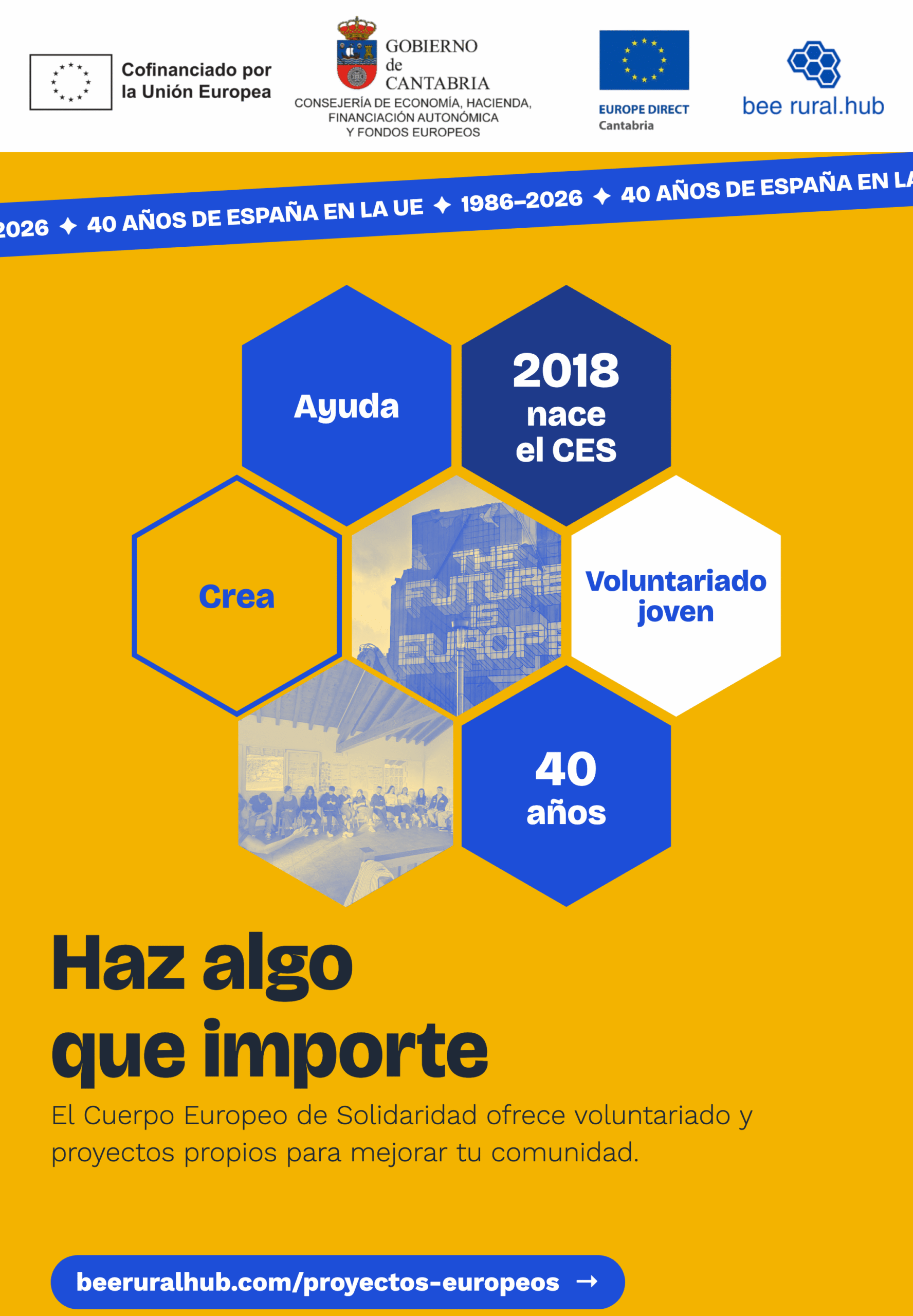
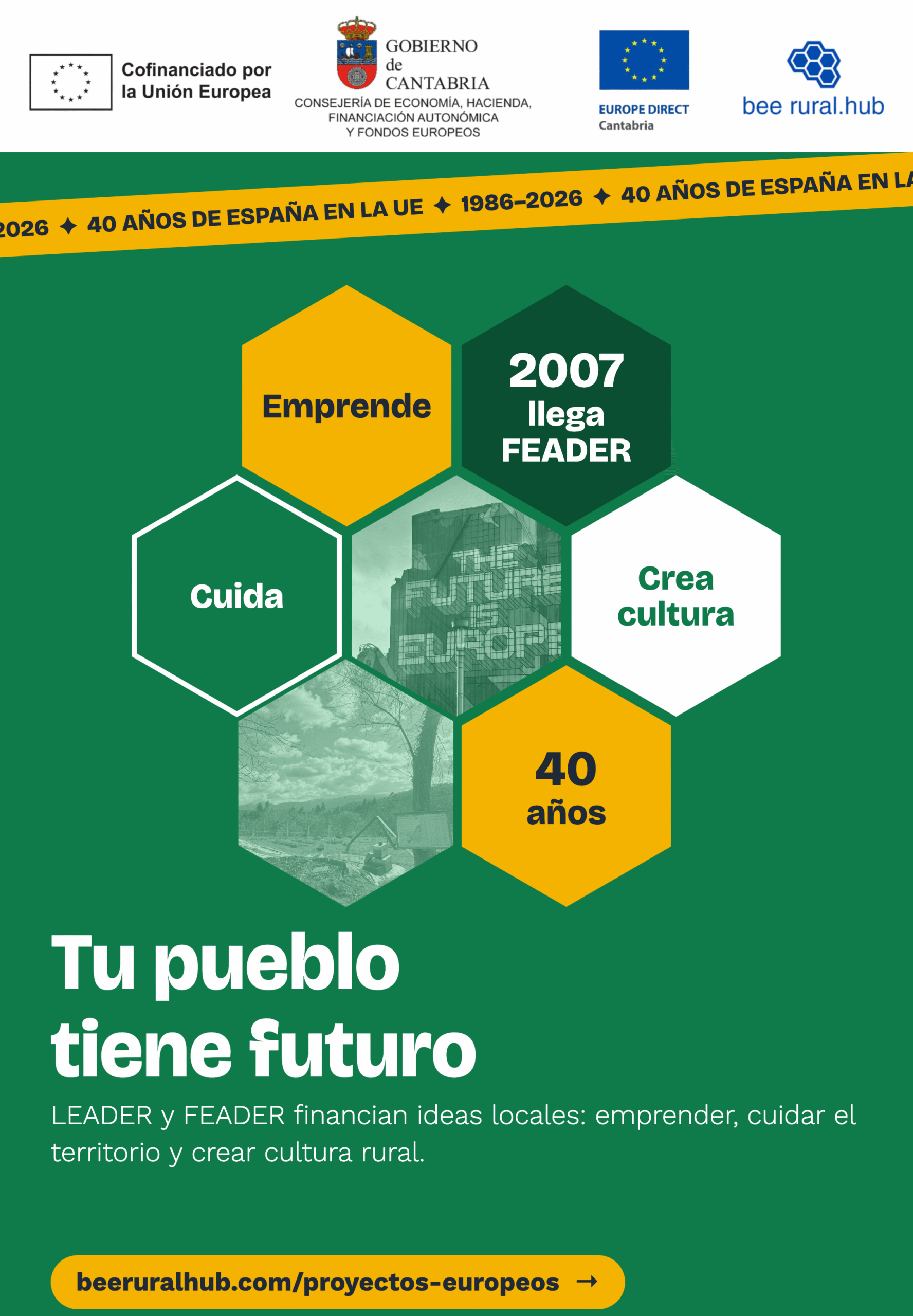
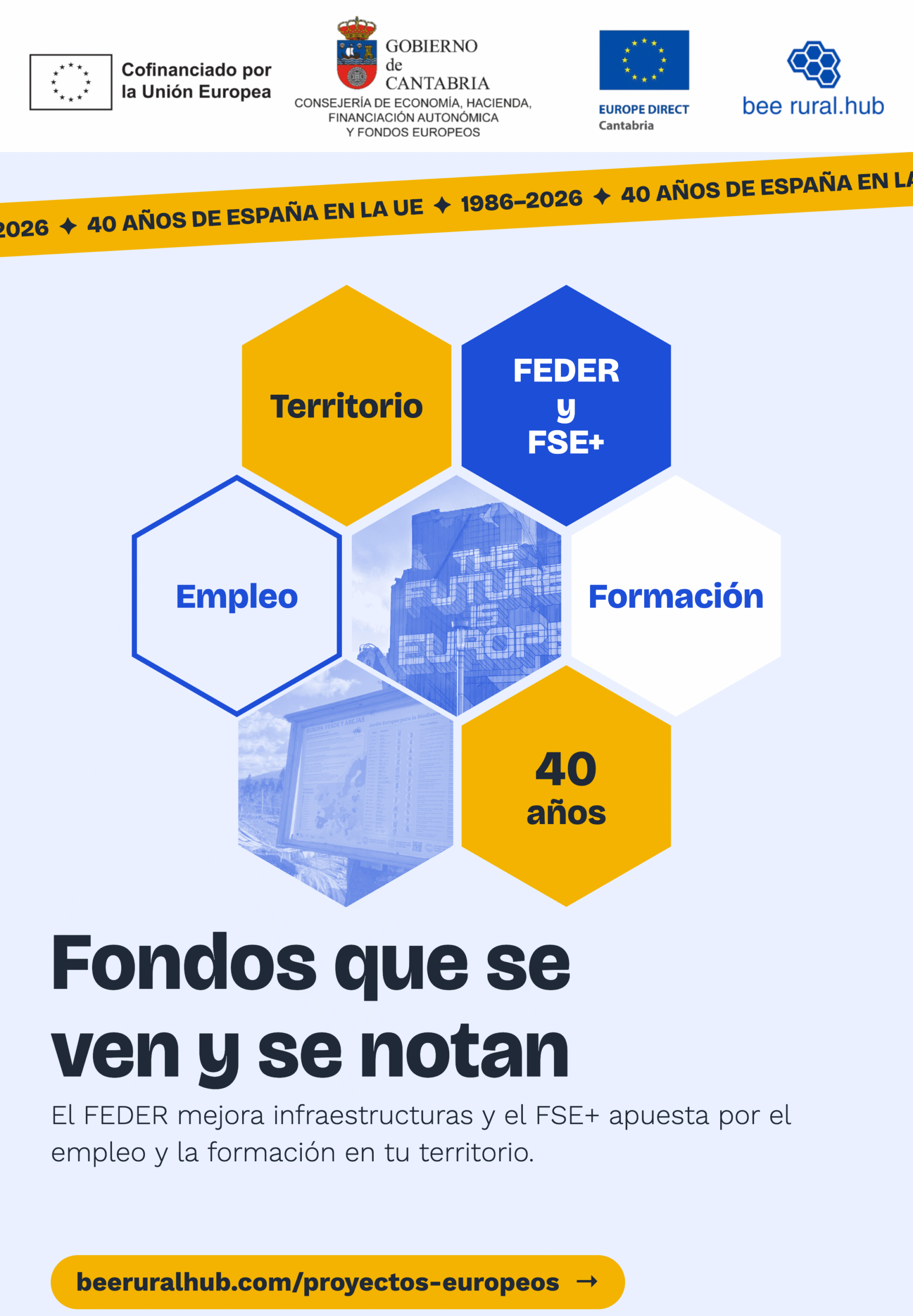
On 1 January 1986, Spain joined the European Union. Forty years later, that membership keeps opening doors for rural areas: youth mobility, training, exchanges and funding for local initiatives. This page brings together the European projects BEE RURAL HUB takes part in from Udías (Cantabria), and serves as an entry point for young people, SMEs and organisations in rural areas who want to learn about the opportunities Europe offers.
What you will find here
- Up-to-date profiles of the association’s active European projects (Erasmus+ and European Solidarity Corps)
- Content and articles on the 40th anniversary of Spain’s accession to the EU and its impact on rural areas
- Dissemination materials: data on Cantabria in Europe, anniversary milestones and activity posters
- Ways to get in touch for young people and rural SMEs interested in European programmes
This hub in numbers (2026)
Cantabria in Europe · flip each card to see the data
What the Government of Cantabria has done with European funds, how they reach rural areas and where to ask for information and support.
Investment in detail
27 R&D&I projects with €2.9M: from an industrial digital twin to the technological transformation of Santoña anchovy.
2023–2027
How it reaches the villages
12 entrepreneur projects with €315,780 in grants: carpentry, gardening, a medical centre and the restoration of the Tres Caños fountain in Comillas.
Europe Direct Cantabria
00 800 67 89 10 11 · In-person, phone and online support on grants, jobs and European programmes.
Infrastructure, innovation and green transition.
Employment, training and social inclusion.
Rural development and depopulation (LEADER).
Youth mobility and volunteering (ESC).
Who it is for
Public administrations, businesses and R&D centres.
Individuals, social organisations and training.
Rural SMEs, entrepreneurs and LAGs.
Young people aged 13 to 30 and youth organisations.
25 young people from 10 countries train as European Solidarity Corps volunteers before their projects in the region.
40 years of Spain in the European Union (1986–2026)
Four decades of European integration that have also transformed rural Cantabria: mobility, training and funding for the villages.
Articles and newsletters
Content linking our European projects to the EU policies that fund them.
Erasmus+ · Education and youth
40 years of European mobility reaching rural areas
Read article
In 1987, barely a year after Spain joined the European Union, Erasmus was born, the programme that has allowed millions of young people to study and live in another European country. Forty years on, its successor Erasmus+ (2021–2027) keeps widening those opportunities, and they now reach rural areas too.
From Udías, Bee Rural Hub coordinates and takes part in Erasmus+ youth projects such as HEARTware (on cyberbullying and digital empathy) and Green Youth on the Move (on sustainability and green skills), bringing together young people from several European countries.
For a young person from a village in Cantabria, this means access to exchanges, training and a European network that once seemed reserved for cities. Europe stops being a distant idea and becomes a concrete experience.
The programme is open to young people with and without university studies, and pays special attention to those with fewer opportunities. That is why work from rural areas matters so much: it brings European mobility to people who would otherwise struggle to access it.
European Solidarity Corps
European volunteering with impact in Udías
Read article
Created in 2018, the European Solidarity Corps (ESC) lets young people aged 18 to 30 take part in solidarity projects in their own country or abroad. The EU covers travel, accommodation, food and pocket money, so that a lack of resources is not a barrier.
Bee Rural Hub is an accredited ESC host organisation in Cantabria. Its volunteers work in agroecology and permaculture, organic beekeeping, bioconstruction, community engagement and communication, on the La Hayuela and Monte Corona farms.
Besides the skills they gain, participants receive official recognition (Youthpass and Europass) and live an experience of active European citizenship in the heart of the countryside.
To host volunteers, an organisation needs the ESC Quality Label, which Bee Rural Hub already holds. Each placement also includes a learning plan and a mentor who supports the young person throughout their stay, so that the experience is educational and not just an extra pair of hands.
EAFRD · LEADER · CAP
Europe funds the future of Cantabria’s villages
Read article
The EU’s Common Agricultural Policy does not only support farmers and livestock keepers: through the EAFRD fund and the LEADER method, it finances rural development and the fight against depopulation.
In Cantabria, the LEADER 2023–2027 programme allocates €26.5 million to rural projects, managed by five Local Action Groups: Asón-Agüera-Trasmiera, Campoo-Los Valles, Liébana, Saja-Nansa and Valles Pasiegos.
The impact is very concrete. In the Saja-Nansa district alone, 12 entrepreneur projects received €315,780 in grants in 2025: from a carpentry workshop and a gardening business to a medical centre and the restoration of the Tres Caños fountain in Comillas.
The Local Action Groups act as the «executing arms» of the Regional Ministry of Rural Development: they support entrepreneurs, assess applications and bring European aid to the territory. Thanks to them, a project born in a small village can access EU funding without leaving its district.
ERDF · ESF+ · Cohesion
1986–2026: 40 years of European funds in Cantabria
Read article
Since joining in 1986, Spain, and Cantabria with it, has benefited from the EU’s cohesion policy, which invests in regions to reduce inequalities. Two funds are key: the ERDF (regional development) and the ESF+ (employment and inclusion).
In 2021–2027, Cantabria’s ERDF programme has €78.8 million, compared with €60 million in the previous period: a 31% increase. The ESF+ adds €37.6 million from the EU, mobilising a total investment of over €60 million.
These funds turn into real projects. In 2026, for example, the Innova grants (ERDF) boosted 27 R&D&I projects with €2.9 million, from an industrial digital twin to the technological transformation of Santoña anchovy.
Cantabria, classified as a «transition» region, can receive European co-financing of up to 60% of the cost of many projects. This multiplies every euro invested by the autonomous community and explains why European funds remain a decisive lever for the region’s development.
Follow us and join the community
We share European opportunities on our social networks. Want to be part of it? Join the Bee Rural Hub community.
Activity co-funded by the Government of Cantabria. Data: Directorate-General for European Funds and Rural Development, Government of Cantabria (ERDF/ESF+ 2021–2027 and LEADER/PEPAC 2023–2027).
English for Tourism
English for Tourism and Hospitality for Rural SME Management
See full information
English for Tourism is an Erasmus+ project focused on improving practical English skills and intercultural communication for rural tourism professionals and SMEs.
Summary
- Duration: 24 months
- Participants: rural tourism professionals, SMEs and entrepreneurs
- Focus: English applied to tourism, marketing and internationalisation
Key areas
- Functional English applied to rural tourism
- Customer care and intercultural communication
- Tourism marketing and digital presence
- Sustainable development and promotion of local heritage
- Inclusion and opportunities in rural areas
Objectives
- Language skills: improve practical English
- Professional communication: build confidence with international visitors
- Internationalisation: support the promotion of tourism services
- European cooperation: strengthen networks between tourism and training organisations
Expected impact
- Individual: improved skills, confidence and employability
- Local: a stronger rural tourism sector
- European: reusable training resources and a replicable model
European Solidarity Corps
Volunteering at Bee Rural Hub — Cantabria, Spain
See full information
What is the ESC?
An EU initiative that lets young people (aged 18–30) volunteer in solidarity projects in their own country or abroad. It covers travel, accommodation, food and pocket money.
Volunteering at BEE RURAL.HUB
- Agroecology and permaculture: food forest, workshops, biodiversity monitoring
- Sustainable construction: recycled structures, event spaces
- Organic beekeeping: hives, flower gardens, educational campaigns
- Community engagement: inclusive workshops and support
- Communication: photo/video, social media, accessible design
- Sustainable tourism: trails, signage, digital promotion
Facilities
- Rural house in La Hayuela: kitchen, dining room, bathrooms, greenhouse, WiFi
- Monte Corona farm: geodesic dome, cabin, tents and apiary
- 200+ m² of multipurpose spaces
Benefits for volunteers
- Skills in permaculture, bioconstruction, beekeeping and digital communication
- Intercultural exchange and active European citizenship
- Recognition: Youthpass + Europass + mentoring
Strategic objectives 2026–2028
- Agroecological models and regenerative training
- Pollinator conservation and responsible ecotourism
- Democratising access to European programmes
HEARTware: Install Empathy Upgrade Humanity
Cyberbullying, digital empathy and responsible citizenship
Open information and HEARTware Toolkit
HEARTware is an Erasmus+ youth exchange on cyberbullying, digital empathy and intercultural collaboration. After five days in Udías (30 Sep – 4 Oct 2026), the project leaves an open toolkit with the training materials, facilitation tools and pieces created by the young people themselves.
Summary
- Duration: 16 months (March 2026 – July 2027)
- In-person exchange: 5 days at La Hayuela, Udías (Cantabria)
- Participants: young people from 5 countries
- Focus: cyberbullying, digital empathy, wellbeing, youth leadership
Partners
- BEE RURAL.HUB (Spain) – applicant
- KAIZEN (Türkiye) – digital literacy
- EUROPEAN M.I.N.D. (Romania) – mindfulness and wellbeing
- KOCLJEVINA (Slovenia) – social eco-farm
- UmanaMente-APS (Italy) – youth empowerment
Expected impact
- Individual: digital literacy, empathy, resilience and Youthpass
- Community: rural youth empowerment and peer mentoring
- European: toolkit and replicable model
Five-day route
Connect, understand, respond, create and share. Each day has its PDF recap and the facilitation posters made by the group.
Day 1 · Who are we?
Connect and build safety
Group agreements, prejudice, power and privilege (Power Flower).
Day 2 · Understand
What, who and how
What cyberbullying is and is not, roles, amplifiers and the forces that sustain harm.
Day 3 · Respond
What can change the system?
Documented cases, points of change, response filter and Response Toolkit.
Day 4 · Make
Turning learning into something useful
Criteria, creative brief, test between teams and usage sheet.
Day 5 · Share
Integrate, transfer and celebrate
Presentation, Youthpass, transfer, evaluation and a surf closing.
Facilitation slides
Ten slides to run sessions on cyberbullying. Open them, print them at A3 and use them with your group.
Space
What the group needs for the space to be safe.
Day 1Conditions
Conditions that make harm possible.
Day 2Rewards
What the person causing harm gains.
Day 2Barriers
What prevents people from intervening.
Day 2How / Who worksheet
Worksheet to analyse who acts and how the system works.
Day 2Petals
Petals to reflect on context and power.
Day 1Project Brief
Summary of the challenge and the mission.
Day 4Harvesting
Harvest of learnings at the end of each block.
AllBody
Body activation and care.
AllCelebration
Group closing and celebration.
Day 5Response Check
A tool born on Day 3 and the most cited by the groups. Before recommending a response to a case of cyberbullying, run it through three questions.
Answer the three questions to see whether the idea stays (KEEP) or changes (CHANGE).
Group scale
HELPSDEPENDSCAN MAKE IT WORSEIf someone is at immediate risk, tell a trusted adult or the emergency services (112 in Spain).
Dragon Dreaming: from idea to action
Dragon Dreaming is a methodology for designing collaborative projects in four phases. In HEARTware it is the thread that takes the group from understanding cyberbullying to creating something useful and celebrating it together. Bee Rural Hub integrates it into its work with young people and the exchange facilitators know it well: Julia Ramos is a co-author of the guide Dragon Dreaming in Action.
Dream
What we want to change and for whom. It starts from a shared dream, not from a list of problems.
Plan
Turn the dream into clear goals and shared tasks.
Do
Act with commitment and check how the team is doing along the way.
Celebrate
Recognise what was achieved and learned, and leave the story told for the next group.
Tools to use with your group
- Check in / check out: a round at the start and end to see how each person arrives and leaves.
- Talking stick: whoever holds it speaks; everyone else listens.
- Generative questions: open questions that open up ideas instead of closing debates.
- Nonviolent Communication: facts, feelings, needs and requests, without blame.
- SMART goals: define what will be done, when and how you will know it is done.
How it fits with the toolkit
- Dream: Day 1, group agreements and safe space.
- Plan: Days 2 and 3, understanding the problem and filtering responses with the Response Check.
- Do: Day 4, creating videos, a podcast and a poster.
- Celebrate: Day 5, presenting, closing with Youthpass and surfing.
This is a proposal for replicating the toolkit, not the exact programme of each session.
Body and nature against digital stress
HEARTware uses the body as a tool, not as a reward. Responding before reacting starts with knowing how to pause, breathe and come back to the body.
Yoga and regulation
Days 1, 3 and 4 · with Javi
Sessions to close intense days with presence and rest. Closing question: how does our state change after stopping and returning to the body?
What participants say: of the 22 responses, 15 rate it «Excellent», 2 «Very good» and 5 «Good».
Surfing and nature
Day 5 · Cantabrian beach
Movement, nature and togetherness after five days of work on a difficult topic. It is voluntary and there is always an equivalent alternative.
How it connects to cyberbullying: it practises emotional regulation, presence and mutual care, which are the basis of responding before reacting.
Four pauses to use with your group
- Ten minutes of body activation at the start of the day, accessible and with no compulsory contact.
- A round of «how is my energy?» before working on difficult cases.
- A yoga or breathing session at the end of an emotionally intense day.
- An activity in nature with an alternative for anyone who prefers not to take part.
Created by the young people
Awareness-raising pieces on cyberbullying created by the teams on Day 4 and presented on Day 5.
Video 1
Video 2
Podcast
Poster
Dissemination campaign
Participants, partners, facilitators and collaborating organisations shared the project with #HEARTware and #DigitalEmpathy. The three top Instagram posts total 4,413 views (2,368, 1,287 and 758).
Instagram · closing post
«HEARTware: a week that left its mark on Udías».
HW-C-IGSInstagram · highlighted stories
Story threads from the exchange.
HW-C-LILinkedIn · Bee Rural Hub
Call and project report.
Exchange gallery
Photos and videos from the week in Udías. Use the arrows, the keyboard or the thumbnails.
How to replicate it
Choose a day, print the slides and use the Response Check. All materials carry a code so you can cite them.
| Code | What it is |
|---|---|
| HW-D1 … HW-D5 | Recap of each day and facilitation posters |
| HW-F-01 … HW-F-10 | Facilitation slides |
| HW-B-01, HW-B-02 | Yoga and surfing as regulation tools |
| HW-P-V1, V2, POD, POS | Videos, podcast and poster by the participants |
| HW-C-IG, IGS, LI | Dissemination campaign pieces |
How to cite
HEARTware Toolkit (Bee Rural Hub, 2026). Erasmus+ project 2025-3-ES02-KA152-YOU-000375861, co-funded by the European Union. Views and opinions expressed are those of the authors only.

Digital Steps for a Green Future
Eco-friendly digital tools for young people with fewer opportunities
ReLoop · waste-to-resource app for rural neighbourhoods
Interactive prototype created at BRH: sort bottles, kitchen scraps and used oil, find where to drop them off in your neighbourhood and see them come back as garden tools, vegetables and soap. Example data.
ReWear
Circular fashion: location-based clothes swapping, tokens and community fairs.
See full information
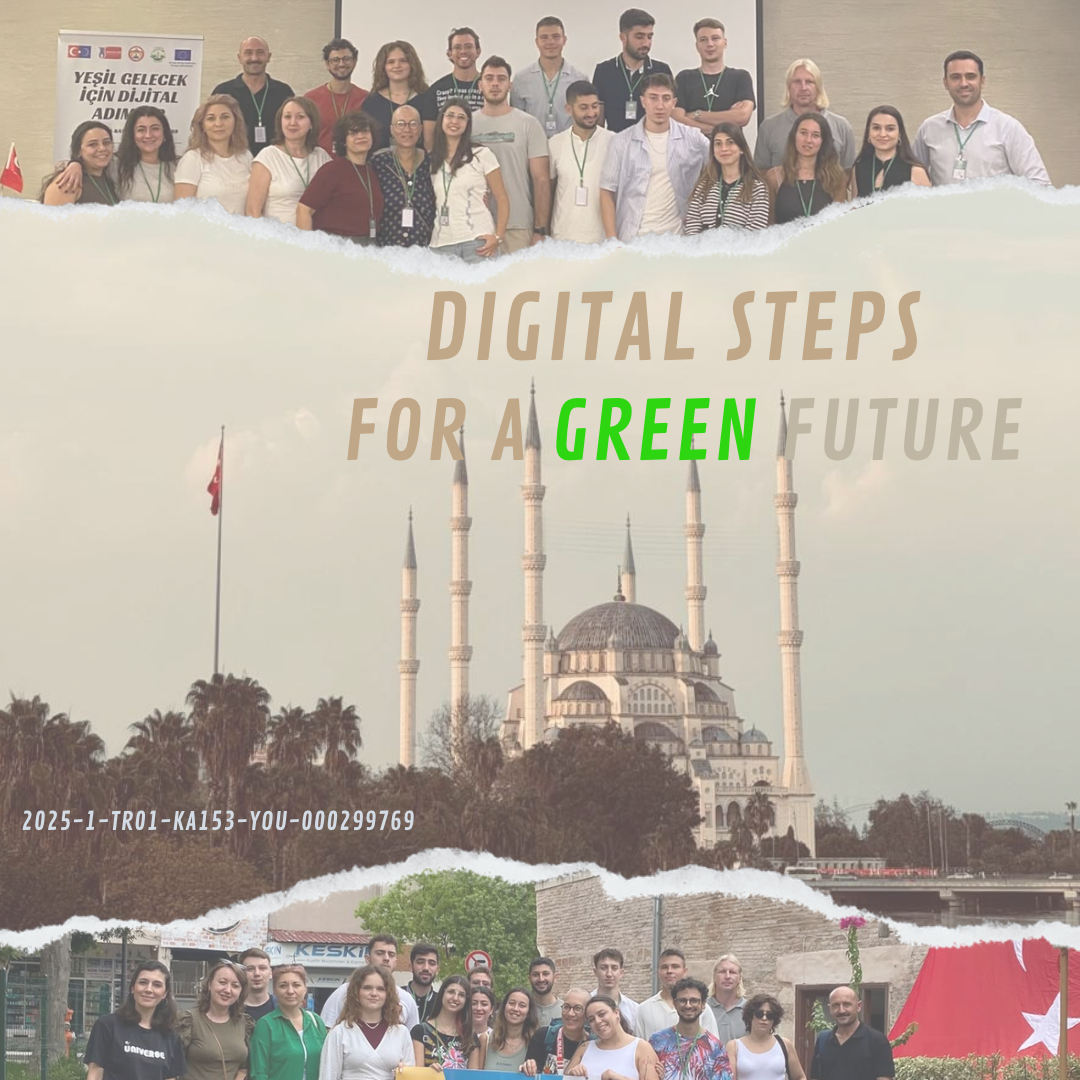
Digital Steps for a Green Future is an Erasmus+ project bringing together organisations from Türkiye, Spain, France, Romania and Italy to develop the digital skills of young people with fewer opportunities in using apps linked to renewable energy, zero waste and waste management, promoting behaviour change and environmental protection.
Summary
- Coordinator: Adana Governorship (Adana, Türkiye)
- Partners: Asociación Bee Rural.Hub (Spain), Mitra France (France), Asociația I.A.T.A (Romania), Edu Lab (Italy)
- Programme: Erasmus+ (European Union)
- Dates: 02/11/2025 – 01/05/2027 (18 months)
Objective
Develop the skills of disadvantaged young people in using digital apps related to renewable energy, zero waste and waste management, and contribute to protecting the environment by promoting behaviour change in these areas.
Main activity · Professional Development Activity
- Dates: 12–16 October 2026 (5 days + 2 travel days)
- Venue: Adana Governorship (Adana, Türkiye)
- Participants: 20 youth workers (4 per country; one of them with fewer opportunities)
Content
- Basic digital literacy for using eco-friendly apps
- Presentation of 10 innovative digital apps (IoT, AI, cloud, virtual reality…) on renewable energy, zero waste and waste management
- Workshops to create digital shopping guides and «zero waste» shopping lists
- Digital manual with good practices: recycling apps, energy saving and consumption reduction
- Exchange of good practices between organisations in the sector
Follow-up activities
- Green technology training: each country will train 30 disadvantaged young people from its region
- Green technology fairs: public fairs where the apps will be presented to the community
Participant profile
- Aged 20 or over, with at least 2 years of active work experience
- English level A2 or above and basic digital skills
- Experience in Erasmus+ or other international projects and in youth work
- Basic knowledge of the environment and climate change
- Attention to gender equality and priority for people from disadvantaged groups or with fewer opportunities
Accommodation and travel
- Venue: Adana city centre · Ramada Adana (double rooms, bathroom, air conditioning, wifi)
- Meals: three meals a day included at the hotel
- Arrival: 11/10/2026 · Departure: 17/10/2026
- Private transfer airport (Çukurova, ~45 km) – hotel
Funding (Erasmus+)
- Meals, accommodation and activities fully covered
- Travel according to the Erasmus+ distance calculator: Spain €580, France €395, Italy €309, Romania €309
- Reimbursement by bank transfer after the activity, on presentation of original tickets and boarding passes (not screenshots)
- Travel and health insurance provided by the coordinating organisation
How to take part
You must read and accept the Participation Agreement and fill in the application form. After selection, a Google Drive folder will be created with each participant’s details. See the full infopack below.
From Silence to Strength
Gender-based violence prevention and active citizenship
See full information
From Silence to Strength (FSS) is an Erasmus+ youth exchange that aims to raise awareness and involve young people in preventing and combating gender-based violence and violence against women, through non-formal education, interactive workshops, experiential activities, art and intercultural cooperation.
Summary
- Dates: 29 November – 8 December 2026
- Place: Loutraki, Corinthia (Greece)
- Age: young people aged 18 to 30
- Focus: gender equality, human rights and active citizenship
Objective
For young people to understand the different forms and causes of violence against women and their individual and social impact, develop empathy and the ability to respond, and become agents of change who promote zero tolerance of violence in their communities.
Participating countries
- 🇬🇷 Greece · 🇹🇷 Türkiye · 🇧🇦 Bosnia and Herzegovina · 🇪🇸 Spain · 🇱🇹 Lithuania
Who can take part
- Young people aged 18 to 30 in transition (from education to work)
- Priority for people with fewer opportunities (economic, social or cultural challenges) and for those who have experienced or witnessed violence
- Interest in gender equality, human rights, social change and active participation; open and collaborative mindset
Travel and arrival
- Arrival: 29/11/2026 to Athens (before 16:00) · group bus transfer Athens–Loutraki
- Departure: 08/12/2026 · group transfer Loutraki–Athens
- Alternatives: suburban train (Proastiakos) + KTEL bus, or X93 bus + KTEL
Funding (Erasmus+)
- Accommodation, meals and activities covered by the programme
- Travel grant by distance band: Spain and Lithuania (2,000–2,999 km) €395 · €535 with «green travel»; Türkiye and Bosnia (500–1,999 km) €309 · €417 with «green travel»
Releaf Through Art
Art as a tool for youth wellbeing and expression
See full information
Releaf Through Art is an Erasmus+ training course that explores art and creativity as non-formal education tools for youth work, emotional wellbeing and the expression of young people with fewer opportunities.
Summary
- Type: training course for youth workers (KA153-YOU)
- Year: 2026
- Place: Athens (Greece)
- Programme: Erasmus+ (European Union)
Themes
- Art and creativity applied to youth work
- Emotional wellbeing, resilience and personal expression
- Non-formal education methods and inclusion
See the full infopack below.
Green Youth on the Move
Sustainability, green skills and active citizenship
See full information
Green Youth on the Move brings together young people from Slovenia, Turkey, Italy and Spain at the Kocljevina social eco-farm to learn about sustainability, green skills and active citizenship.
Mission
- Develop green skills: zero waste, circular economy and sustainable mobility
- Improve teamwork skills and intercultural exchange
- Strengthen active citizenship and environmental responsibility
- Create opportunities for rural young people with fewer opportunities
Activities
- Workshops on eco-farming, herbs and permaculture
- Creative recycling and zero waste activities
- Visits to local sustainable initiatives
- Youth-led digital sustainability campaign
Partners
- Kocljevina (Slovenia) – coordinator
- Youth for Van (Turkey)
- Dimbaya APS (Italy)
- Bee Rural Hub (Spain)
+INFO AND REGISTRATION: forms.gle/QecjgtcmzgHWEgBu8

Erasmus for Young Entrepreneurs
BEE RURAL.HUB, Support Centre of the EU entrepreneurs’ exchange programme
See full information
BEE RURAL.HUB is a Support Centre of the Entrepreneurs’ Mobility consortium, which delivers the European programme Erasmus for Young Entrepreneurs (EYE). EYE lets people who have started or are about to start a business learn, during a stay of up to six months, alongside an experienced entrepreneur running a small or medium-sized business in another participating country. There are no fees to take part.
What we do as a Support Centre
We spread information about the programme, distribute materials and help aspiring entrepreneurs make first contact with the Intermediary Organisations. We also support mentoring processes and facilitate knowledge exchange among partners, with a focus on rural and sustainable entrepreneurship.
Who can take part
- New entrepreneurs: people firmly planning to set up their own business, or who have already started one within the last three years.
- Host entrepreneurs: people who own or manage a small or medium-sized enterprise in one of the participating countries.
Local contact point in Cantabria
Cámara Oficial de Comercio, Industria y Navegación de Cantabria
Plaza Pedro Velarde 5, 39001 Santander
Contact person: Mr Antonio Molleda · Tel. (+34) 942318303 · amolleda@camaracantabria.com
STEM UP
STEM skills, innovation and critical thinking for young people
See full information
STEM UP is an Erasmus+ youth exchange that brings STEM/STEAM skills, critical thinking and innovation to young people, encouraging scientific and digital vocations in rural areas too.
Summary
- Type: youth exchange (KA151-YOU)
- Date: October 2025
- Place: Prahova (Romania)
- Programme: Erasmus+ (European Union)
Themes
- Science, technology, engineering, arts and mathematics (STEAM)
- Digital skills and creativity
- Teamwork, interculturality and youth participation
See the full infopack below.
DigitOpen
Supporting the digital transformation of SMEs and the third sector through open source
See full information
DigitOpen is an Erasmus+ cooperation project (KA220-VET) that supports the digital transformation of micro-enterprises and the third sector through open-source tools, with a training activity (LTTA) in Perugia.
Summary
- Type: cooperation partnership · LTTA (KA220-VET)
- Date: December 2024
- Place: Perugia (Italy)
- Programme: Erasmus+ (European Union)
Themes
- Digitalisation of SMEs and third-sector organisations
- Free software and open-source solutions
- Professional digital skills
See the full guidelines below.
Subjective Tourism
Experiential tourism and youth skills
See full information
Subjective Tourism is an Erasmus+ training course that explores experiential and subjective tourism as a path to personal and professional development for young people, connecting heritage, territory and creativity.
Summary
- Type: training course (KA151-YOU)
- Date: October 2024
- Place: Prahova (Romania)
- Programme: Erasmus+ (European Union)
Themes
- Experiential tourism and heritage storytelling
- Personal development and transversal skills
- Youth entrepreneurship and interculturality
See the training material below.
Green Tiber
Green skills and sustainability in training
See full information
Green Tiber is a small-scale Erasmus+ partnership (KA210-VET) of the «trainer of trainers» type, strengthening green skills and sustainability in vocational training by training trainers.
Summary
- Type: small-scale partnership · Trainer of Trainers (KA210-VET)
- Date: September 2024
- Place: Perugia (Italy)
- Programme: Erasmus+ (European Union)
Themes
- Ecological transition and green economy
- Train the trainers
- Sustainability applied to Vocational Education and Training
See the training material below.

authentic
real experiences across Europe

historic
see for yourself

most valued
discover the experiences
Supporters









bee green
bee rural
bee the change
bee connected
bee wild
bee local
bee digital
bee future
bee creative
bee eco
bee …