
Food Forest
Edible Forest
A growing system that mimics the structure and resilience of a forest. Diversity, cooperation and living soil: it produces food while regenerating the ecosystem.
Nature does not need us to manage it. It only needs us to stop interfering and start cooperating with it. The edible forest is exactly that: learning to grow food the way the forest does.
What is a Food Forest?
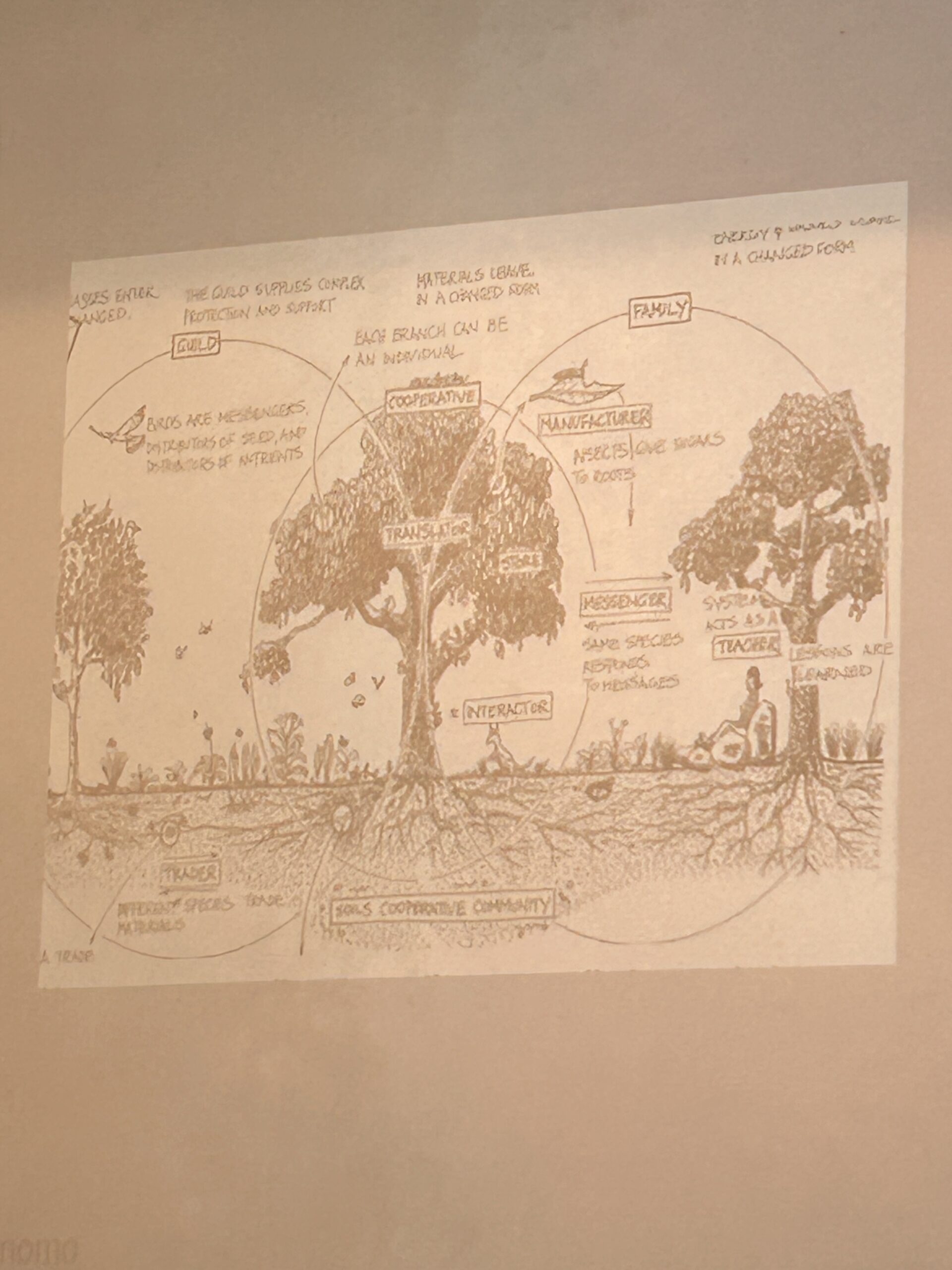
An edible forest is a growing system inspired by the natural forest: multiple layers of vegetation, high species diversity and cooperative relationships between them —mycorrhizae, nitrogen-fixing plants, ground covers, shelter for beneficial fauna—. The aim is to produce food while regenerating soil, water and biodiversity.
Why does it work?
Presence Cards · 35 invitations
Inspired by the Shinrin-yoku method and adapted to the Bee Rural Hub Food Forest. Each card suggests a 10–20 minute activity in the vegetable garden, the pollinator garden, the fruit trees or beside the beehives. Tap a card to read the full invitation.
The buzz
⏱ 10 minutes
Tap to read →
The buzz
10 minSit near the beehives without getting too close. Close your eyes. Let the buzzing come to you, without looking for it. Listen for a tone, whether it rises and falls, whether it comes from far or near. What does that sound tell you? When you open your eyes, watch the flight of a single bee and follow it with your eyes for as long as you can.
Bee Rural Hub · Udías, Cantabria
The dance of the bees
⏱ 15 minutes
Tap to read →
The dance of the bees
15 minBees communicate by dancing. Watch their movement among the flowers for a few minutes. Is there a pattern? Do they prefer a certain kind of flower? How do they land, how do they take off? Then try to imitate the path of a bee in the air with your hand. No rush. Let your hand fly like her. Feel what it is like to know exactly where you are going.
Bee Rural Hub · Udías, Cantabria
The hive guardian
⏱ 10 minutes
Tap to read →
The hive guardian
10 minWatch the entrance of a hive. Guard bees inspect each one that arrives. How many come back loaded with pollen? What colour is it today? The colour of the pollen reveals which flowers they have visited. Stay still and count how many go in during one minute. That number is a small measure of the health of the place.
Bee Rural Hub · Udías, Cantabria
The pollinator’s flight
⏱ 15 minutes
Tap to read →
The pollinator’s flight
15 minChoose an open flower in the pollinator garden and sit beside it. Wait for someone to arrive: a bee, a butterfly, a bumblebee. Do not force the encounter. When it arrives, watch without interrupting. How does it reach the nectar? How long does it stay? Does it go straight to another flower or fly in circles? You are witnessing a very ancient act.
Bee Rural Hub · Udías, Cantabria
The garden that welcomes
⏱ 20 minutes
Tap to read →
The garden that welcomes
20 minWalk through the pollinator garden very slowly, as if visiting someone at home. Notice which flowers are most visited today and which are alone. Gently touch the petals of a flower that is not being visited. How does it smell? Which flower would you start with if you were a bee? At the end, mentally thank each flower, by name or by colour.
Bee Rural Hub · Udías, Cantabria
The solitary bee
⏱ 10 minutes
Tap to read →
The solitary bee
10 minNot all bees live in a hive. Look for signs of solitary bees: small holes in the ground or in wood, insects going alone from flower to flower without the collective buzz. They are just as essential. Reflect: when in your life are you also a solitary bee? What do you pollinate when you work alone?
Bee Rural Hub · Udías, Cantabria
The nectar trail
⏱ 20 minutes
Tap to read →
The nectar trail
20 minWalk around the Bee Rural Hub grounds following only the open flowers. From flower to flower, with no plan. If two flowers are close, choose the one that calls you most. Let the path draw itself, as a bee would. At the end, look back. What route have you traced? Would it return to where you started, as the bee does?
Bee Rural Hub · Udías, Cantabria
Honey time
⏱ 10 minutes
Tap to read →
Honey time
10 minIf you have honey from the place, put a small amount in the palm of your hand. Smell it before tasting it. Can you identify any flower in that aroma? Is it sweet, sour, grassy? When you taste it, do it very slowly. Honey holds thousands of journeys, thousands of flowers, days of Cantabrian sun. Swallow it with that awareness.
Bee Rural Hub · Udías, Cantabria
The garden bed as a map
⏱ 15 minutes
Tap to read →
The garden bed as a map
15 minSit in front of a garden bed and look at it as if it were a map of an unknown territory. Which areas are most alive? Are some edges better cared for than others? Which plants get along and which seem to compete? Draw that map in your mind. Every bed has its own geography. Today you are learning it.
Bee Rural Hub · Udías, Cantabria
Hands in the soil
⏱ 10 minutes
Tap to read →
Hands in the soil
10 minPlace both hands on the soil of the bed, palms down. Without digging, without moving anything. Just listen to what you feel: is it cold or warm? Damp or dry? Compact or spongy? The soil under your hands is alive: millions of microorganisms are at work right now. Take three deep breaths while you keep the contact.
Bee Rural Hub · Udías, Cantabria
The sleeping seed
⏱ 10 minutes
Tap to read →
The sleeping seed
10 minLook in the garden for something that has not sprouted yet, or has only just begun. Place your finger beside it, without touching it. Here is contained life, energy waiting for the exact moment. Think of something of yours that is also in that state: an idea, a project, a wish. What conditions does it need to germinate?
Bee Rural Hub · Udías, Cantabria
Living compost
⏱ 10 minutes
Tap to read →
Living compost
10 minGo to the composting area. Look, smell, observe. What looks like waste is a transformation in progress. Look for worms, fungi, any sign of life. Nothing is lost here, everything is converted. What are you transforming at this moment in your life? What remains of something old are becoming food for something new?
Bee Rural Hub · Udías, Cantabria
Slow watering
⏱ 15 minutes
Tap to read →
Slow watering
15 minIf it is time to water, do it very slowly today. No rush. Watch how the water enters the soil, how the surface changes colour, how the plants respond. Listen to the sound of water touching the leaves and the earth. Slow watering is not only more efficient: it is an act of attention. Each plant is thirsty in a different way.
Bee Rural Hub · Udías, Cantabria
The aromatic herbs speak
⏱ 10 minutes
Tap to read →
The aromatic herbs speak
10 minLook for aromatic herbs in the garden: rosemary, thyme, lavender, mint. Gently rub a leaf between your fingers and bring it to your nose. Close your eyes. Stay with that aroma for at least a minute. Does it evoke something? A memory, a place, a person? Aromatic plants keep memories. Today they have awakened yours.
Bee Rural Hub · Udías, Cantabria
The weight of a fruit
⏱ 10 minutes
Tap to read →
The weight of a fruit
10 minHold a fruit from the garden in your hand —whatever there is today—. Feel it for a moment without looking, by touch alone. Its weight, its temperature, its texture. Then look at it. This fruit took weeks to reach your hand. Sun, water, soil, human care. All of that fits here. Eat it if the moment is right, or put it back carefully.
Bee Rural Hub · Udías, Cantabria
The shade of the fruit tree
⏱ 15 minutes
Tap to read →
The shade of the fruit tree
15 minFind the shade of one of the fruit trees and sit inside it. No phone, no agenda. Notice how the shade has edges that move with the wind. What is on the branches? Buds, flowers, fruit, fallen leaves? This tree has been here longer than many of your memories. Pay attention to it as you would to someone who has something important to tell you.
Bee Rural Hub · Udías, Cantabria
The root that holds
⏱ 10 minutes
Tap to read →
The root that holds
10 minGo to the foot of a fruit tree. The invisible system beneath you perhaps reaches as far as the branches you see above. Put one hand on the trunk. Notice whether it is cold, rough, damp. This tree is anchored to the same ground you are standing on. You both share the earth.
Bee Rural Hub · Udías, Cantabria
The tree’s cycles
⏱ 15 minutes
Tap to read →
The tree’s cycles
15 minLook at a fruit tree and imagine its whole year: the burst of blossom in spring, the slow formation of fruit in summer, the harvest, the falling of leaves, the winter rest. Now ask yourself which season you are in. Are you in bloom, in fruit, in harvest, or in necessary rest? There is no wrong answer.
Bee Rural Hub · Udías, Cantabria
The falling fruit
⏱ 10 minutes
Tap to read →
The falling fruit
10 minWalk beneath the fruit trees and look for fruit that has fallen to the ground. Look at it closely. Who is already eating it? Are there insects, birds, signs of visitors? A fallen fruit is not a failure, it is a gift to the soil. Think of something you have recently let go of. Is it nourishing something without your knowing yet?
Bee Rural Hub · Udías, Cantabria
The forest that feeds
⏱ 20 minutes
Tap to read →
The forest that feeds
20 minWalk slowly through the food forest, identifying everything that is edible. Fruit, herbs, flowers. You do not need to know it all: it is enough to notice how many forms of food live together in one space without anyone asking for them. An edible forest is a utopia made earth. What would you like to plant here if you could?
Bee Rural Hub · Udías, Cantabria
Mindful pruning
⏱ 15 minutes
Tap to read →
Mindful pruning
15 minLook at the branches that have been pruned: their cuts, the resulting growth pattern. Each cut directs the tree’s energy somewhere else. Pruning is an act of intention: removing what does not serve so that the essential can grow stronger. What do you need to prune right now?
Bee Rural Hub · Udías, Cantabria
Saffron in bloom
⏱ 15 minutes
Tap to read →
Saffron in bloom
15 minIf the saffron is in bloom, sit beside the bed and look at the flowers one by one. They are ephemeral: they last only a few days. Notice the exact colour of the petals, from lilac to violet. Look for the red stigmas inside. Bring your nose close: the aroma is subtle, almost medicinal. This flower is one of the most precious treasures of the plant world.
Bee Rural Hub · Udías, Cantabria
The stigmas of time
⏱ 10 minutes
Tap to read →
The stigmas of time
10 minSaffron demands patience: months underground, a few days in flower, a delicate hand harvest. Three stigmas per flower. Hold that image. Think of something in your life that also requires that kind of patient waiting and careful gathering. Are you treating it with the same delicacy it deserves?
Bee Rural Hub · Udías, Cantabria
The colour of autumn
⏱ 10 minutes
Tap to read →
The colour of autumn
10 minSaffron blooms in autumn, when everything else is withdrawing. It is a flower that goes against the current. Go outside and look for that contrast: what is fading and what still shines. Saffron reminds us that some lives bloom precisely when the world rests. When in your life have you bloomed against the current?
Bee Rural Hub · Udías, Cantabria
The patience of the bulb
⏱ 10 minutes
Tap to read →
The patience of the bulb
10 minThe saffron bulb spends months buried, with no visible signs. In that time it is not dead: it is storing energy for the exact moment. Place your hands on the soil of the bed. Practise trusting in what you cannot see yet. Patience is not passivity: it is active faith.
Bee Rural Hub · Udías, Cantabria
The smell of damp earth
⏱ 10 minutes
Tap to read →
The smell of damp earth
10 minAfter the rain —or after watering a little— crouch close to the soil and breathe in deeply. That smell has a name: petrichor. It is produced by soil bacteria releasing geosmin. You are smelling microbial life. It is one of the most universally comforting aromas for humans. Stay in that smell for a few minutes. Let it calm you.
Bee Rural Hub · Udías, Cantabria
The Cantabrian mist
⏱ 15 minutes
Tap to read →
The Cantabrian mist
15 minWhen there is mist in Udías —and there often is—, go out and stand still in it. Mist erases the edges of the landscape and makes everything more intimate. Watch how the plants receive it: the leaves shine, the ground dampens without rain. Mist is water that walks. What becomes clearer when the horizon disappears?
Bee Rural Hub · Udías, Cantabria
The sound of the wind
⏱ 10 minutes
Tap to read →
The sound of the wind
10 minClose your eyes and listen to the wind in the plants and trees. Does it sound the same in large leaves as in small ones? Is there a difference between the wind in the fruit trees and in the herbs of the bed? The wind has no sound of its own: it takes the sound of everything it touches. Listen to the whole landscape as if it were a score that changes every second.
Bee Rural Hub · Udías, Cantabria
Walking barefoot
⏱ 15 minutes
Tap to read →
Walking barefoot
15 minTake off your shoes. Walk on the grass, the earth, the stones of the path. Go slowly, very slowly. Each step is a conversation between your body and the ground. Notice the differences in temperature, texture, firmness. The ground of Bee Rural Hub has its own language underfoot.
Bee Rural Hub · Udías, Cantabria
The taste of the place
⏱ 10 minutes
Tap to read →
The taste of the place
10 minFind something edible straight from the garden: a mint leaf, a strawberry, a rocket shoot. Before eating it, look at it, smell it. When you put it in your mouth, close your eyes. This flavour holds the water of Cantabria, this year’s sun, the soil of Udías. It is an edible place. What does this place taste like today?
Bee Rural Hub · Udías, Cantabria
Light between leaves
⏱ 10 minutes
Tap to read →
Light between leaves
10 minLie down under a tree or sit looking up through the branches. Watch how the light passes through the leaves: the green becomes translucent, the edges glow. That light has travelled 150 million kilometres to filter exactly through this leaf, at this moment, towards your eyes. Let that be as astonishing to you as it is.
Bee Rural Hub · Udías, Cantabria
The touch of the bark
⏱ 10 minutes
Tap to read →
The touch of the bark
10 minPlace both hands on a tree trunk. Explore the bark with your fingers: the cracks, the mosses, the lichens, the smooth areas. Close your eyes so that touch is the only active sense. Every tree has a different texture, like a fingerprint. How would you describe this bark without using comparisons?
Bee Rural Hub · Udías, Cantabria
Productive silence
⏱ 20 minutes
Tap to read →
Productive silence
20 minFind the quietest place in the grounds. Sit down. Doing nothing. No task. Let the surroundings exist without your intervention for twenty minutes. Discomfort may arise, an urge to get up. Simply notice it and stay. The garden does not need you to watch it in order to work. Sometimes the best contribution is to be there without intervening.
Bee Rural Hub · Udías, Cantabria
Breathing with the garden
⏱ 10 minutes
Tap to read →
Breathing with the garden
10 minPlants take in carbon dioxide and release oxygen. You do the opposite. They are literally breathing what you exhale, and you breathe what they release. Sit among the plants and breathe consciously, knowing you are in constant exchange with everything around you. You are not visiting the garden: you are part of its breathing cycle.
Bee Rural Hub · Udías, Cantabria
Gratitude to the place
⏱ 15 minutes
Tap to read →
Gratitude to the place
15 minBefore you leave, take a slow walk around Bee Rural Hub. Stop in front of each area: the pollinator garden, the beds, the fruit trees, the beehives. Say aloud or silently a single word of gratitude to each one. This place has been built with work, care and vision. You too are part of what makes it possible.
Bee Rural Hub · Udías, Cantabria
35 cards · Tap any to read the full invitation
The 7 layers of the edible forest
We design the way a forest does —in vertical layers— to make the most of light, space, moisture and nutrients.
Frequently asked questions
How long does an edible forest take to mature?
Shrubs produce during the first or second year. Understory fruit trees start between years 3 and 5, and the system reaches maturity after 7–10 years. The more mature the forest, the less intervention it needs.
How is it different from a conventional vegetable garden?
A conventional garden needs tilling, frequent watering, fertilisers and permanent pest control. The Food Forest copies the resilience of the forest: it generates its own fertility, regulates water and controls pests naturally.
Can I visit the Bee Rural Hub Food Forest?
Yes. We organise guided visits, volunteering days and regenerative design workshops. Write to us at beeruralhub@gmail.com or use the form at the bottom of this page.
How we design it at Bee Rural Hub
Before planting, we observe: light, prevailing winds, water flows, soil type and spontaneous species. The place tells us what it needs.
Each plant is chosen for what it contributes: shade, flowering for pollinators, nitrogen fixation, attracting beneficial fauna, food.
We build the soil before planting: deep mulch, compost, minimal tillage and permanent plant cover.
We plan flowering and harvests spread across the whole year, ensuring continuity for pollinators in every season.
Light pruning, efficient watering and shelters for biodiversity. No herbicides, no pesticides, no deep tilling.
Project video
→Life in the Food Forest
A visual tour of the layers, the flora, the pollinators and the people who keep the forest alive through the seasons.
Food Forest gallery
Growing layers, blooms, community work and the evolution of the forest through the seasons.
Get involved
The Food Forest grows with the community. There is a place for everyone: from family visits to citizen research or active volunteering. Choose how you want to join in.
bee like us
bee rural
bee the change
bee sense
bee wild
bee solidarity
bee digital
bee future
bee creative
bee eco
bee you
bee someone
bee …