What is the European Green Deal?
European Green Deal
Green Europe refers to the European Green Deal, the European Union’s main strategy to transform its economy into a sustainable, fair and climate-neutral model by 2050. Its central aim is to reduce greenhouse gas emissions, protect biodiversity and encourage more efficient and responsible use of natural resources.
Far from being a single measure, the European Green Deal encompasses a set of initiatives in key sectors such as energy, transport, industry, agriculture and sustainable finance, with the aim of driving a comprehensive ecological transition across the EU.
Pillars of the European Green Deal
- Climate neutrality: making Europe the first climate-neutral continent by 2050, balancing emissions with nature’s capacity to absorb them.
- Sustainable growth: promoting an economic model that decouples growth from intensive resource use, encouraging green jobs, innovation and local development.
- Just transition: making sure no one is left behind, supporting the most vulnerable people, businesses and regions to adapt to the changes.
- Green finance: mobilising financial resources, including the NextGenerationEUrecovery funds, to finance sustainable investments.
- Solid legislative framework: turning the goals into binding laws, such as the European Climate Law, which sets mandatory emission reduction targets for all Member States.
The European Green Deal, launched in 2019, is the EU’s growth strategy that sets out the path towards a complete ecological transition, with the ultimate goal of reaching climate neutrality by 2050. It is the EU’s contribution to the Paris Agreement, which commits to limiting global warming to a maximum of 1.5 °C above pre-industrial levels.
The European Council, together with the European Parliament, has adopted the legislation needed to turn the strategy into binding rules and provisions that apply in all Member States.
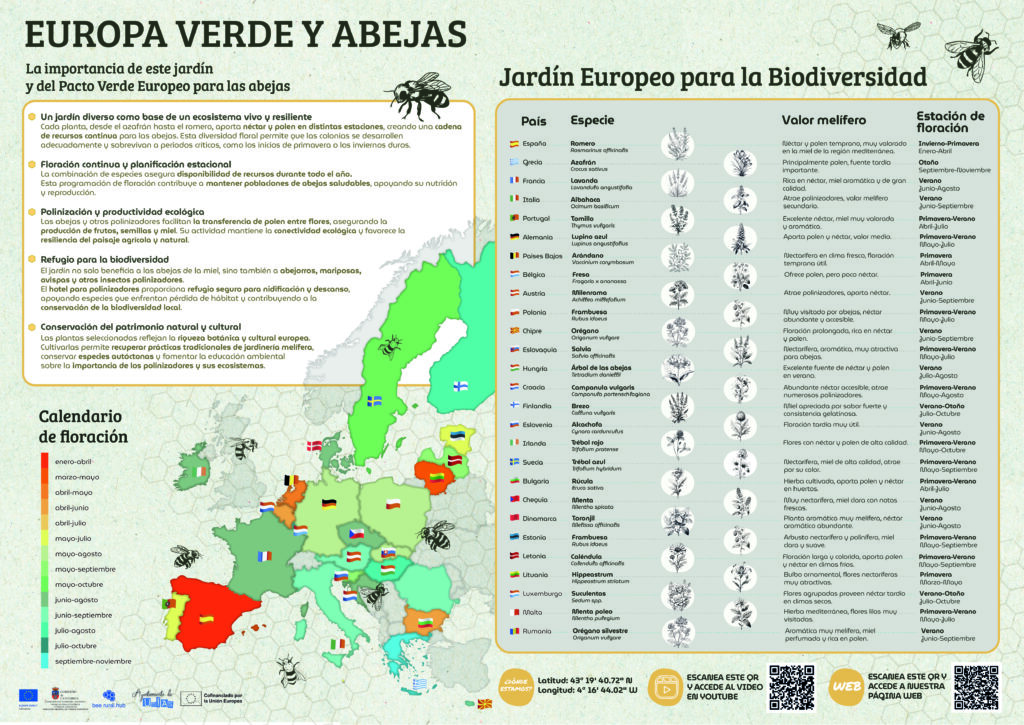
Green Europe and Bees: A European Garden for Biodiversity
A living space
dedicated to conserving and experiencing the natural wealth around us. our garden is much more than a place: it is a community project that brings together education, participation and sustainability to protect local and European biodiversity. here you will find themed areas, native plants, habitats for pollinators and activities open to all ages.
We invite you to discover, learn and connect with nature while contributing to a greener, healthier future for everyone.
Why Pollinators?
They are essential for biodiversity and food production; the Green Deal promotes their protection through ecological restoration and sustainable agriculture.
The EU Birds and Habitats Directives protect species and their habitats by establishing protected areas and conservation plans. Some unique European species, such as the Iberian lynx, have been saved from extinction thanks to EU-funded measures.
EU countries will have to put in place effective restoration measures for at least 20% of the EU’s land and sea by 2030 and for all degraded ecosystems by 2050.
Biodiversity
The diversity of life is essential for ecosystems to function well. EU rules aim to halt biodiversity loss and increase species populations.
Pollinators
Bees and other species pollinate flowers, which is essential for growing crops. The EU wants to reverse the decline of pollinators, such as bees and birds.
Forests
Forests absorb 10% of the EU’s emissions every year. The EU wants to improve forests and their biodiversity to help fight climate change.
Water and rivers
The EU has measures to reduce pollution of surface and groundwater, and wants to remove barriers in rivers to improve ecosystem health.
Farmland
70% of EU soils are in poor condition. The EU aims to reduce soil pollution and make agriculture more environmentally friendly.
Urban areas
Trees in cities are essential for mitigating heat. EU measures aim to make cities greener and therefore more liveable.
Why does biodiversity matter?
Biodiversity is the cornerstone of life. It is essential for humans, the environment and climate protection. It provides food, fresh water and clean air and plays an important role in the balance of nature. It helps tackle climate change and prevents the spread of infectious diseases.
According to the World Economic Forum, almost half of global GDP (some €40 trillion) depends on the natural environment and its resources. All the most important economic sectors depend heavily on nature and together contribute around €7.3 trillion to the global economy.
Up to 200 species go extinct every day
Human activities, which cause pollution and habitat disruption, as well as climate change, put pressure on species and ecosystems. Scientists estimate that currently one million species of plants, insects, birds and mammals are threatened with extinction worldwide.
In short
The European Green Deal is much more than an environmental policy: it is an economic and social transformation plan that seeks to build a cleaner, more competitive, inclusive and resilient Europe, able to lead the global fight against climate change.
a living space dedicated to conserving and experiencing the natural wealth around us.
Acknowledgements
From the Green Europe and Bees: A European Garden for Biodiversity project, we want to express our sincere thanks to the Regional Ministry of Economy, Finance, Regional Funding and European Funds of the Government of Cantabria for its support and co-funding.
Thanks to this collaboration, we are creating a living space that fosters biodiversity, drives sustainability and connects citizens with the importance of protecting bees and pollinators as essential allies for our shared future.
The institutional support received not only strengthens the impact of our actions in Cantabria, but also reinforces the European commitment to a greener, fairer and more supportive development.
bee …
bee rural
bee the change
bee connected
bee wild
bee skilled
bee digital
bee future
bee sustainable
bee eco
bee …